

Published on Apr 07, 2026
Tongue Drive system (TDS) is a tongue-operated unobtrusive assistive technology, which can potentially provide people with severe disabilities with effective computer access and environment control.
It translates users’ intentions into control commands by detecting and classifying their voluntary tongue motion utilizing a small permanent magnet, ecured on the tongue, and an array of magnetic sensors mounted on a headset outside the mouth or an orthodontic brace inside.
We have developed customized interface circuitry and implemented four control strategies to drive a powered wheel chair (PWC) using an external TDS prototype.
The magnetic sensors are nothing but hall-effect sensors. A Hall Effect sensor is a transducer that varies its output voltage in response to changes in magnetic field. In its simplest form, the sensor operates as an analogue transducer, directly returning a voltage. With a known magnetic field, its distance from the Hall plate can be determined.
The control system consists of Hall Effect sensor and microcontroller. Microcontroller collects data from the sensor and Microcontroller makes to move the motors of the wheel chair in appropriate direction. The direction is decided by the microcontroller depending on the magnet present at different Hall Effect sensors. The microcontroller is loaded with intelligent program written using embedded ‘C’ language.
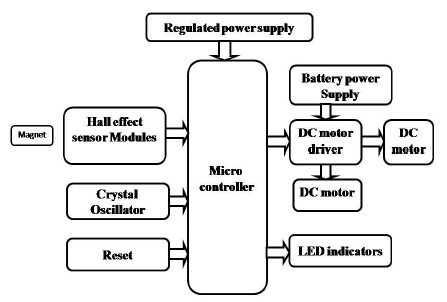
The objectives of the project include:
Characteristics of Hall effect sensors.
High torque Geared DC Motors and Driver interfacings.
