

Published on Apr 07, 2026
To capture any image of the human and send it to the PC using wireless audio and video Communication for defense.
This system involve to Monitoring and controlling the system using four different modules,
1) Flying Robot Control Unit
2) Wireless control Unit
3) Sensing and Control Unit
4) PC and Control unit
Development of a suitable lightweight system in which a sensor is airborne for carrying out surveillance. The sensor should remain airborne for a minimum of 2 minutes at a minimum height of 30 meter and above to do imaging of a proportionate area below. Recognizable real time video information should be transmitted to the ground receiver point suitably located in the observation area. Sensor should be able to detect man-sized objects in above-mentioned conditions.
Proposed solution should take up design of configuration and identification of suitable options for sensor, data link, ground observation & ontrol points and other support system(s). System configuration details comprising of sensor, data link, observation, data processing mechanism and support system should form part of the design.
There are many approaches for motion detection in a continuous video stream. All of them are based on comparing of the current video frame with one from the previous frames or with something that we'll call background This application supports the following types of video sources:
AVI files (using Video for Windows, interop library is included);
updating JPEG from internet cameras;
MJPEG (motion JPEG) streams from different internet cameras; local capture device
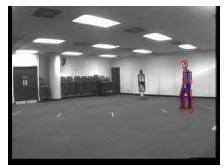
It is to add motion alarm feature to all these motion detection algorithms. Each algorithm calculates a binary image containing difference between current frame and the background one. So, the only we need is to just calculate the amount of white pixels on this difference image. For some algorithms it could be done even simpler. For example, in blob counting approach we can accumulate not the white pixels count, but the area of each detected object. Then, if the computed amount of changes is greater than a predefined value, we can fire an alarm event.
