


Published on Apr 07, 2026
• This design is characterized by fewer leaves whose thickness varies from centre to ends following a parabolic curve .
• In this design, inter-leaf friction is reduced by spacers, and therefore there is only contact between the springs at the ends and at the centre where the axle is connected.
• Not as "stiff" as conventional "multi-leaf springs".
•When a leaf spring is compressed, the length of the leaves changes and the leaves slide on each other.
• This sliding action could be a source of noise and can also produce friction.
• Weight of single steel leaf spring is around 9.2kg.
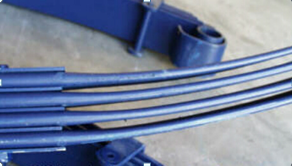
• The automobile industry has shown increased interest in the replacement of steel leaf spring with fibre glass reinforced polymers.
• To match Reduce the weight of the steel leaf spring by introducing composite material.
• With increase in the fatigue life of the spring.
• Increase the Stiffness of the leaf spring.
A four-leaf steel spring used in the rear suspension system of light vehicles is analyzed using ANSYS V5.4 software.
• The finite element results showing stresses and deflections verified the existing analytical and experimental solutions.
• Using the results, a composite one made from fiberglass with epoxy resin is designed and optimized using ANSYS.
• Main consideration is given to the optimization of the spring geometry. The objective was to obtain a spring with minimum weight that is capable of carrying given static external forces without failure.
