


Published on Apr 07, 2026
This project report deals in depth with our project Ground Source Cooling System.In this project we have designed and established a closed loop ground source cooling system so as to have a future alternative to traditional heating, and air conditioning systems. Closed Loop Ground Source Cooling System use relatively constant temperature of the ground to regulate the temperature of a home or building at very high effective efficiency.
The system does not create heat through combustion of fuel or passing electricity through resistors; it moves heat from the ground to the home/building for heating and
the opposite direction for cooling. In so far as the heat in the ground that these systems use is supplied by the sun, they are using renewable energy.
As an additional benefit, ground source cooling/heating system can provide inexpensive hot water, either to supplement or replace entirely the output of a conventional, domestic water heater. Ground source heating and cooling is cost effective because it uses energy so efficiently.
At the initial stage the project work was divided in to two parts:
1) Digging 5 X 5 X 10 feet deep
2) Preparing the rest of the apparatus as per the drawings
Ground Source cooling uses the earth or ground water or both as the sources of heat in the winter, and as the "sink" for heat removed from the home in the summer. For this reason, Ground Source cooling systems have come to be known as earth-energy systems (EESs). Heat is removed from the earth through a liquid, such as ground water or an antifreeze solution, upgraded by the heat pump, and transferred to indoor air. During summer months, the process is reversed: heat is extracted from indoor air and transferred to the earth through the ground water or antifreeze solution.
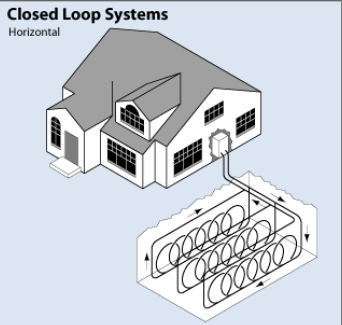
The ground source cooling system requires three primary components; loop of G.I. pipes, a liquid pumps pack, Coolant and a radiator (heat transfer device). A loop field can be installed horizontally or vertically as convenient The most common oolant is water. Its high heat capacity and low cost makes it a suitable heat-transfer medium. It is usually used with additives, like corrosion inhibitors and antifreezes.
Antifreeze, a solution of a suitable organic chemical (most often ethylene glycol, diethylene glycol, or propylene glycol) in water, is used when the water-based coolant has to withstand temperatures below 0 °C, or when its boiling point has to be raised. Very pure demonized water, due to its relatively low electrical condctivity, is used to cool some electrical equipment, often high-power transmitters. Heavy water is used in some nuclear reactors; it also serves as a neutron moderator.
