


Published on Apr 07, 2026
The radial engine is an internal combustion engine configuration in which the cylinders point outward from a central crankshaft like the spokes on a wheel. This configuration was very commonly used in aircraft engines before being superseded by turboshaft and turbojet engines. It is a reciprocating engine.
The cylinders are connected to the crankshaft with a master-and-articulating-rod assembly. One cylinder has a master rod with a direct attachment to the crankshaft. The remaining cylinders pin their connecting rods attachments to rings around the edge of the master rod (see animation). Four-stroke radials almost always have an odd number of cylinders, so that a consistent every-other-piston firing order can be maintained, providing smooth running.
The Radial Engine is a reciprocating type internal combustion engine configuration in which the cylinders point outward from
a central crankshaft like the spokes on a wheel. This type of engine was commonly used in most of the aircrafts before they started using turbine engines. In a Radial Engine, the pistons are connected to the crankshaft with a master-and-articulating-rod assembly. One of the pistons has a master rod with a direct attachment to the crankshaft.
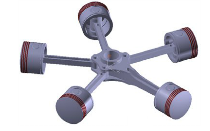
The remaining pistons pin their connecting rods` attachments to rings around the edge of the master rod. Four-stroke radials always have an odd number of cylinders per row, so that a consistent every-other-piston firing order can be maintained, providing smooth operation. This is achieved by the engine taking two revolutions of the crankshaft to complete the four strokes.
Which means the firing order for a 9-cylinder radial engine is 1,3,5,7,9,2,4,6,8 and then again back to cylinder number 1.This means that there is always a two-piston gap between the piston on its power stroke and the next piston on fire(the piston on compression).
If an even number of cylinders was used the firing order would be something similar to 1,3,5,7,9,2,4,6,8,10 which leaves a three-piston gap between firing pistons on the first crank shaft revolution, and only onepiston gap on the second crankshaft revolution. This leads to an uneven firing order within the engine, and is not ideal
Most radial engines use overhead poppet valves driven by pushrods and lifters on a cam plate which is concentric with the crankshaft, with a few smaller radials. A few engines utilize sleeve valves instead.
Although not that used nowadays radial engine is a cute little engine that was in the beginning of the aerospace transportation. It was very helpful and mainly used because of its small weight and size. That makes it comfortable and suitable for any machine that is close of space. Despite of its small size and weight it does not make it less powerful than other engines.
The same way the in-line engines are more powerful with more cylinders it is more powerful with more rows of cylinders. It was also comfortable for the World War II airplanes when the engine was in its peak. When it is war you need more space for fuel, power, weapons and bullets than any other things and than any other time.
